How inflation developed in 2023 and what to expect in the coming months
“High inflation takes away our savings.” Every Czech has heard this phrase at least once in recent years. But what do the numbers say about this year's price growth, and what developments can (not only) investors expect in 2024?
.avif)
(This article is NOT investment advice)
While normally the topic is the subject of debate among economists and other experts, this year and in 2022 the word “inflation” has made its way into every household's living room. And even more interested investors.
No wonder — the Czechs have had a period where they had to endure one of the highest price increases in history. This was reflected both in their regular spending and in savings accounts or at home “under the pillow.” By the way, that's why More Czechs have started investing in recent months than ever before.
The good news is that the worst is probably over. Since September 2022, when inflation in the Czech Republic reached a record 18%, the price increase has slowed significantly and is approaching the values we were used to between 2010-2020.
Inflation is, in simple terms, the rise in prices, or the repeated increase in price in a given economy. As a result of inflation, the purchasing power of money decreases, so people buy fewer goods or services for the same amount than before. In addition, the rise in prices also has a negative impact on the savings of citizens.
Inflation slowed in 2023, but still not enough
However, despite the slowdown, inflation is high enough for the average person to feel it in their wallet.
At the time we were preparing this article (second half of November 2023), the most recent statistics available were those reporting price increases for October 2023. In the tenth month of the year year-on-year inflation in the Czech Republic rose to 8.5%, which was 1.6% more than in September. However, as stated by the Czech Statistical Office, the increase was mainly caused by the projection of the so-called. Economical tariff in electricity prices. Without it, inflation would actually fall to 5.8%.
Did you know that the average ROI on Investown was around 10% in 2023? Thus, our investors are currently surpassing the current annual inflation rate.
Much more interesting, however, is the fact that average annual inflation in October it was 12.1%,. To put it another way: those who did not invest or did not secure a different appreciation of their finances, the increase in the price of their savings in a single year cut off more than 12% of the real value of money.
What is the difference between annual inflation and average annual inflation? The first figure expresses the price increase compared to the same month of the previous year (i.e. October 2023 and 2022, for example). Average annual inflation then reflects the percentage change in the price level over the past 12 months against the average over the past 12 months.
As the data shows, Investing is now more important than ever. in this millennium. The highest interest rates on current savings accounts at banks are around 5-6%, so they still fall far short of covering inflation.
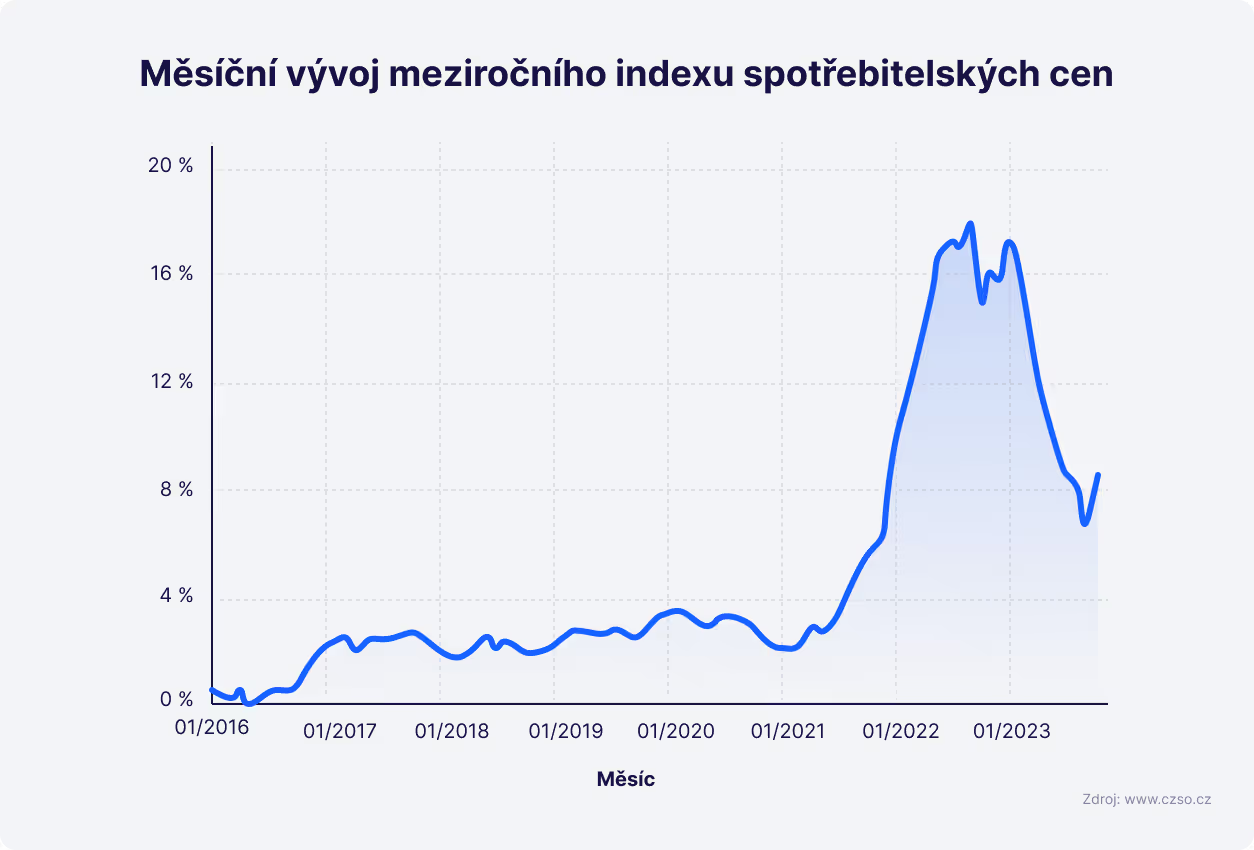
Recall that the long-term goal of the Czech Central Bank is to keep inflation at 2%. But we will have to wait a while before price rises return to this level (if it happens at all in the near future).
For those who did not invest or obtain a different appreciation of their finances, the increase in price from their savings in a single time cut off more than 12% of the real value of the money.
How are they doing abroad?
Let's not just stay in the Czech Republic and let's look beyond the borders for context, namely to the entire European Union and the USA. We find that inflation in the Czech Republic is, for many reasons, one of the highest in Europe, and we are second only to Hungary.
Data from Eurostat show that: annual inflation in the European Union fell to 3.9% in October 2023, in euro area countries (i.e. where the euro is paid), it was even only 2.9%.
The United States also experienced a regular decline in price growth, where the October price increase stopped at 3.2%.
Outlook for 2024
The above inflation data is important, but of course investors care much more about what will happen in the months ahead. Even if no one has a crystal ball, economists have traditionally tried to predict the evolution of inflation and the economy as a whole, at least in part.
One of the most current forecasts offered, for example Ministry of Finance of the Czech Republic. According to him, price growth will decrease significantly in 2024, yet will be around 3% and the CNB is also unlikely to reach its inflation target in the next 12 months.
A little more optimistic is herself. Czech National Bankwhich expects to increase prices by 2.6% in 2024.
According to the Ministry of Finance of the Czech Republic, inflation will be around 3% in 2023.
Estimates differ, of course, in part, but there is a majority consensus among economists from state institutions and the private sector that inflation in the Czech Republic will continue to decline during 2024. Which is Great news for investors at Investownwho are thus very likely to significantly outperform inflation in the next 12 months.
The ideal is to invest regularly
Regardless of whether the experts' predictions about inflation come out or not, it makes sense to invest regularly. As the data shows, the most successful in the long run are patient investors with a longer investment horizon, who benefit from the so-called compound interest.
If you're not investing yet, it's never too late to start.
This article is not investment or financial advice
Investown does not provide investment or financial advice. This is an educational article with basic information on the evolution of inflation. For specific advice, we recommend using the services of an investment advisor.