

How to invest during high inflation?
Current inflation and impending economic recession are adversely affecting the attractiveness and performance of the assets in which investors put their finances. Read which direction to take, and which one, on the contrary, to avoid during high inflation, what are the forecasts and why it is not worth leaving money lying in an account in the bank.

Global economy slows
The global economy is growing at a slower pace than economists had expected. The main causes are Covid, the war in Ukraine and rising interest rates. An economic recession is also imminent, in which energy and inflation crises may gradually transform.
The growth outlook for the global economy for 2023 has been downgraded by the International Monetary Fund (IMF). Gross domestic product (GDP) is projected to increase by only 2.7 percent from July's original outlook of 2.9 percent. The deterioration of the outlook also affects the Czech economy.
The Organisation for Economic Co-operation and Development (OECD) projects that eurozone growth will slow. Next year, the decline is projected to 0.3 percent from 3.1 percent this year. The OECD also warns that further interruptions in energy supplies will increase inflation in Europe. Very unfavorable are the forecasts in neighboring Germany, which is dependent on Russian gas. According to the OECD, the decline will be 0.7 percent, compared with 1.7 percent growth expected in June 2022.
The United States is less dependent on energy imports than European nations, but it is still going into a downturn. The base interest rate has hit its highest level in the US since before the financial crisis erupted in 2008.
The last time the Federal Reserve had such a strict approach to monetary policy was in the early 1980s.
US economist Nouriel Roubini expects a long recession towards the end of 2022, which he says could persist in the US and globally throughout 2023.
Despite the worsening outlook of leading economies and the above forecasts, there is a high probability that further increases in interest rates, and thus also household and corporate indebtedness.
In the Czech Republic, inflation rose to 18 percent
Unfortunately, the economic crisis does not escape the Czech Republic either. In September 2022, the price level increased by 18% year-on-year and inflation accelerated compared to August.
This is the highest year-on-year inflation figure since December 1993.
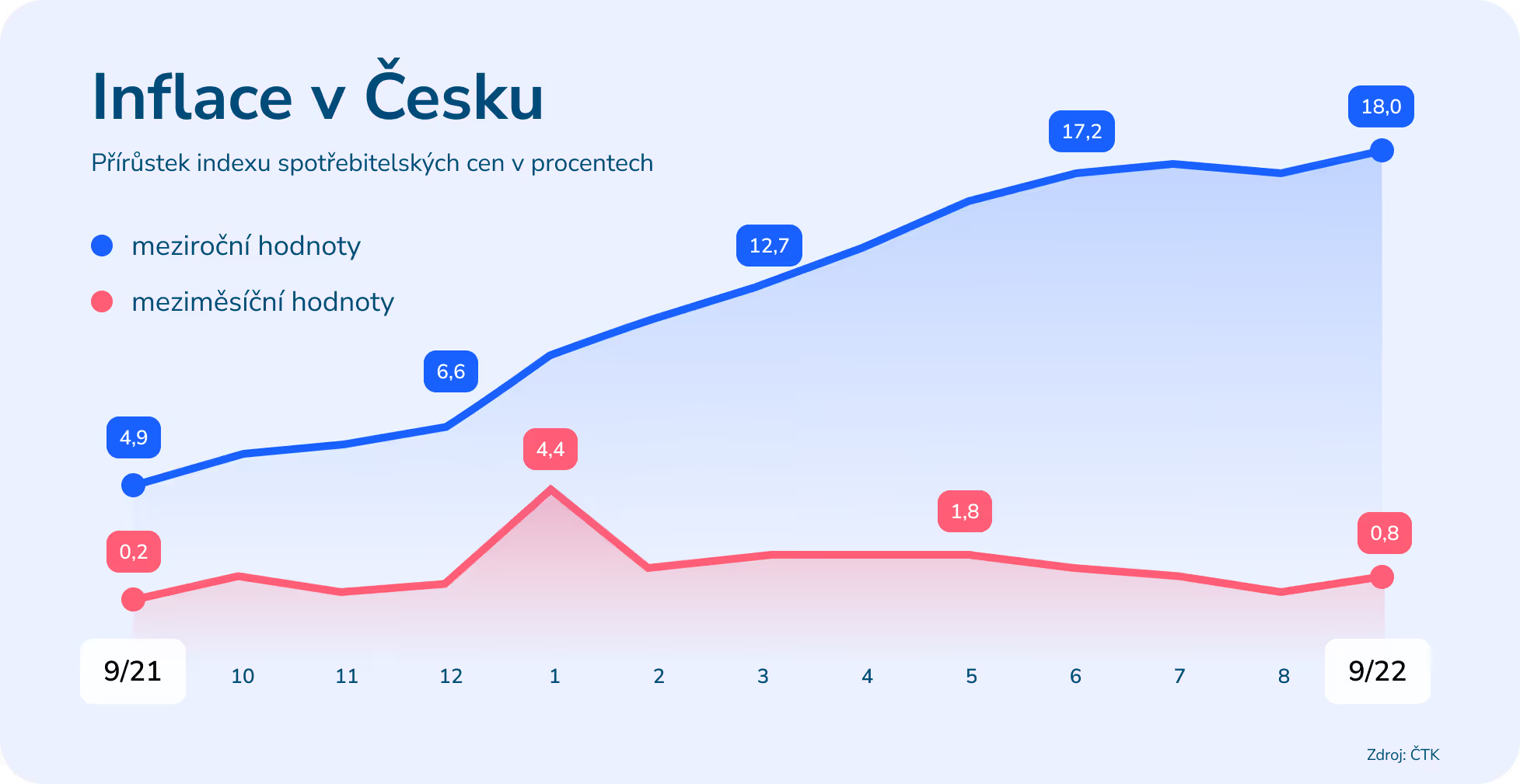
According to the Czech Statistical Office, consumer prices also rose by 0.8 per cent month-on-month.
Energy should not remain unnoticed either.
- Natural gas prices up more than 15 percent compared to August 2022
- Electricity price up 3.6 percent
- Rents from apartments rose 5.2 percent
- Increases also occurred in aqueous, curdled and warm water
Increasing the cost of the “roof over your head” logically affects housing affordability and the entire real estate market, which has seen a cooling in the past 6 months. Despite only a slight decrease in housing prices, however, the Czech Republic ranks among the countries with the worst housing affordability in the world. The monthly mortgage payment for a 2+kk apartment is practically equal to the average net wage in Prague, which is a rather drastic ratio.
How to invest in times of inflation?
High inflation rates and record price rises have a negative impact on all those who hold finances in current or savings accounts. Even the best savings accounts are not able to cover inflation (in September 2022, Trinity Bank offered the best interest rate of 5.58% per annum for deposits up to CZK 400,000). The same is true of term deposits.
The economic situation complicates the decision-making between individual investment plans, which is why it is necessary to choose a more sophisticated approach than depositing money in a bank account.
The goal of every investor in the current time should be to diversify the portfolio and seek professional investment partners with transparent (and, of course, good) results.
On the contrary, it is worth avoiding assets with high volatility such as cryptocurrencies, but also a number of equity securities or mutual funds.
Bitcoin has lost approximately 74% in less than a year. Similarly, Ethereum is the second largest. This cryptocurrency traded for almost $4,900 last November, currently the price is around $1,250.
For example, the S&P 500, a stock index comprising stocks of the 500 largest publicly traded companies in the U.S., hit its lowest level of 2022 due to global stock sell-offs at the end of September 2022. According to Barry Bannister, an analyst at Stifel, there are several catalysts that may drive the S&P 500 index out of current levels 19% higher in the first quarter of 2023. Bonds are also undergoing a dramatic fall due to the aforementioned rise in interest rates. If you do not want to face the fluctuations of the markets, choose stability and fixed interest.
What are more stable investments
Investing in real estate should be part of diversifying the portfolio of any investor who prefers consistent long-term returns and looks at gains over the longer term.
The outlook for real estate, even in today's complicated economic times, in contrast to other assets, remains positive.
The good news is that, at the same time, the downturn in the mortgage market is not making building land cheaper. According to the Mortgage Bank Index, they were 24% more expensive in the second quarter than in the same period last year. For apartments it is 21% and for houses it is 20%.
The above are a practical indicator for anyone deciding how to handle finances in times of crisis. As a way, it offers the allocation of free funds to more stable investments, including primarily real estate. These offer stability and low volatility and, in the case of group investing, have a clearly given fixed interest.
Investing “conservatively,” that is, in real estate, is certainly sensible in times of uncertainty. The real estate market has long been one of the most stable and profitable ways of investing.
__________