

Is there a recession coming? What are the global economic forecasts for 2023?
Forecasts for 2023 do not suggest anything super-optimistic. At the moment, no one knows how much longer the war in Ukraine will last, how, especially in Europe, the energy crisis will be resolved, and how inflation will develop further, or how COVID-19 will affect the economy.

Global economic activity is experiencing a sharper than expected slowdown, according to the latest forecast from the International Monetary Fund (IMF), largely due to inflation, which is currently the highest in several decades. The outlook is particularly affected by the cost-of-living crisis, tightening financial conditions in most regions, the Russian invasion of Ukraine and the ongoing Covid-19 pandemic.
Global GDP growth is expected to slow to 3.2% in 2022, according to the IMF. In 2023, it expects a further slowdown to 2.7 percent.
International Monetary Fund chief Kristalina Georgieva said the risks of a recession in 2023 increased, mainly due to interest rate hikes continued by central banks around the world. Georgieva also said that skyrocketing prices must be brought under control, but a necessary tax on that may be slowing economic growth.
Other world institutions are even more pessimistic with the current forecasts:
- American Investment Bank Morgan Stanley expects 2.2 percent growth, as well as the OECD (Organisation for Economic Co-operation and Development).
- In an investment bank Goldman Sachs estimates 1.8%.
- Bank of Britain Barclays expects growth of just 1.7%.
For context:
In the last pre-Covid year, the world economy grew by 2.8%.
In the covid year 2020, it fell by 3.3%.
And in 2021, it grew by 5.8%.
With the exception of the crisis year 2009 and the covid crisis in 2020, this would be 1.7 percent growth slowest since 1993.
Real GDP growth
Annual percentage change
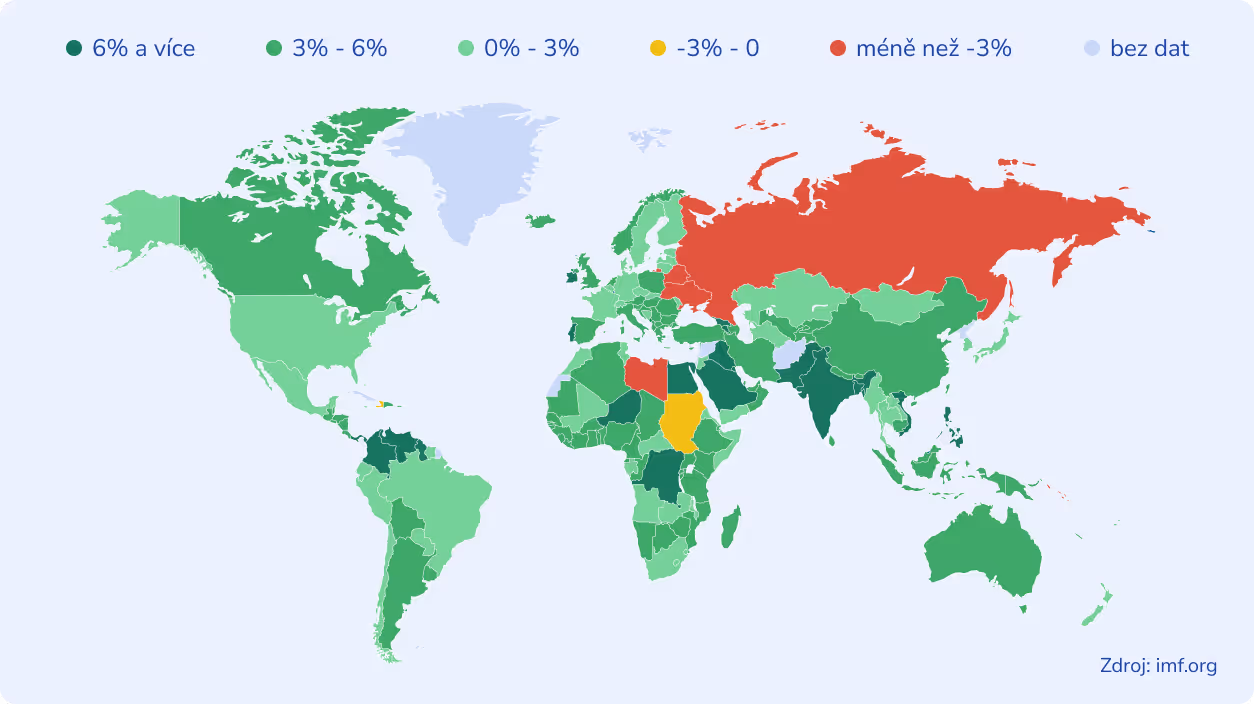
Asia drags entire world, west on brink of recession
According to economic forecasts, China is likely to be the engine of the world economy in 2023, where the easing of anti-COVID measures will allow growth of up to 5%. On a completely different level is India, GDP is forecast by the IMF to rise by 6.8% this year and by 6.1% in 2023 — the most of the world's major economies. Economic growth in India is mainly driven by investment in manufacturing and energy transformation supported by advanced digital infrastructure.
But the Asian economy is not only made up of China and India. Rapid growth is also expected in other countries in the region, which should benefit the global economy. Growth in Asia should boost export demand in Europe, improve supply chains and help manage inflation. This is positive news.
In Europe and the United States, however, the situation is unlikely to be so favorable. According to the IMF forecast, both regions will only narrowly avoid recession (a fall in GDP).
- The IMF expects the US economy to grow by 1%.
- In the euro area, it is only 0.5%.
Morgan Stanley, the investment bank, predicts that the eurozone economy will contract by 0.2% in 2023. This is due to the ongoing energy crisis and the fight against high inflation, which climbed to an annual rate of 10.7% in October 2022.
Nor is the UK economy likely to fare well, which grew by 7.5% in 2021 and 4.2% a year later, according to estimates. Largely due to double-digit inflation, however, it is expected to fall by 1.5% in 2023, marking the biggest economic slump of any major economy except Russia.
The Eurozone and the UK are likely to be on the brink of recession mainly due to rising energy bills. But European officials have already managed to reduce the share of Russian gas in imports without a crushing decline, and therefore the eventual recession should not be too drastic.
The Federal Reserve (Fed) expects a recession in the US in 2023 with a 45% probability. That's the highest percentage estimate in history. The Fed chief said the Fed is not trying to trigger a recession, but is determined to bring rising prices under control, even if it risks an economic downturn. According to some analysts, the real likelihood of a recession is even higher.
Economic forecast for 2023

Slowing growth and falling inflation are likely to lead to a gradual reduction in interest rates. Ellen Zentner, chief economist at Morgan Stanley, said she “expects the target range to peak at 4.5% to 4.75% by January 2023, maintain at that level through 2023, and then gradually decline throughout 2024.”
Fighting high inflation through interest rate hikes that are supposed to result in reduced economic output is proving to be a common feature of many world economies in 2023.
Goldman Sachs says in its macroeconomic outlook that “the key economic question for 2023 is whether central banks will be able to reduce inflation to more acceptable levels without triggering a recession.”
One risk is the continued rise in interest rates due to high inflation, which could plunge both the US and Europe into a deeper recession. The second risk is that if inflation succeeds, central banks may react by easing conditions too late.
Geopolitical developments also remain a threat, particularly in Eastern Europe and the Middle East. This will determine the evolution of energy prices.
How does the World Bank look at it?
World Bank analysts predict that central banks may have to raise interest rates by another 2 percentage points to reduce global inflation to a target rate of around 2%.
Combined with financial market tensions, global GDP growth could slow to 0.5% or even decline by 0.4% in 2023. That would meet the technical definition of a “global recession.”
However, global inflation should not reach its peak until the fourth quarter of 2022, according to the World Bank.
Indeed, slowing demand, falling prices due to increased inventories and falling house prices should, among other things, help to ease inflation, prompting major central banks to stop raising rates on an ongoing basis. It seems that everything will depend on the evolution of inflation - the faster it is managed to tame it, the lower the probability of a recession.
World Bank President David R. Malpass commented on worldbank.org: “Global growth is slowing sharply and is likely to slow further as more countries fall into recession. I have deep concerns that these trends will persist, with long-term consequences that will be devastating for people in emerging and developing economies. “
In his statement, he added that “in order to achieve low inflation rates, currency stability and faster growth, national economies could reorient themselves from reducing consumption to increasing production. Governments should strive to generate additional investment and improve productivity and capital allocation, which are critical to growth and poverty reduction”.
Global inflation is forecast to rise from 4.7% in 2021 to 8.8% in 2022. However, after this, it should gradually begin to fall to 6.5% in 2023 and to 4.1% in 2024.
According to the CNB and MF, the Czech Republic is heading for a mild recession
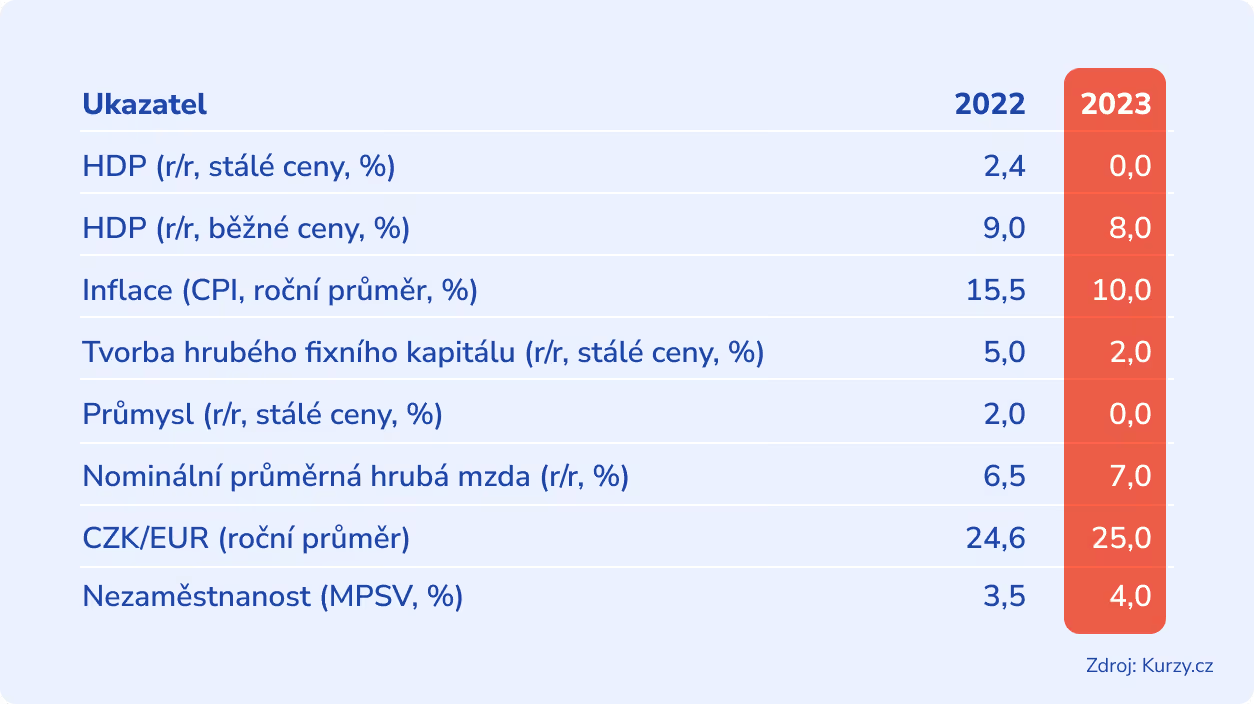
According to the Czech National Bank's autumn forecast, which is based on data as of October 21, 2022, the Czech GDP will grow by only 2.2% in 2022. It is expected to fall by 0.7% in 2023. It is expected to return to 2.5% growth in 2024.
The annual headline inflation rate is projected to rise by an astronomical 15.8% in 2022 and 9.1% in 2023. It will begin to gradually return to the long-term target of around 2% in 2024, when it is estimated that it should reach a year-on-year change of 2.4%.
What does the Treasury say about it? In 2023, GDP could stagnate.
Households are also set to face the effects of high inflation next year, and their real consumption should decrease slightly.
The consumption of the general government sector and the formation of gross fixed capital will continue to be pro-growth. Weaker stockpiling year-on-year, however, is likely to slow the economy significantly. The effect of overall weak domestic demand will partly dampen the foreign trade balance.
Comorian national economic forecast, November 2022
What will happen in the markets?
The prospect of a recession in developed countries leads experts to make pessimistic forecasts for the coming year, including in financial markets.
Mike Wilson, chief U.S. equity strategist and chief investment officer at Morgan Stanley, predicts that stocks will suffer a double-digit decline in early 2023. Still, the S&P's target for next year is 3,900 points — roughly equivalent to November and December 2022. At the same time, Wilson is warning investors that US companies are preparing to cut profits, which may also cause stock prices to fall.
In its forecast, US investment management company Vanguard says rising interest rates, inflation and geopolitical risks have forced investors to rethink their optimistic expectations. The good news is that this year bear market improved the outlook for global equities. Vanguard's projections suggest that greater opportunities to make a profit are outside the United States.
Specifically, Vanguard states in its forecast that “the valuation of the US stock market in 2021 was unsustainable, and the framework for determining fair value suggests that it still does not reflect current economic realities.” It said the "30% decline in emerging markets over the past 12 months made valuations in these regions more attractive.” And at the moment it expects similar returns to developed markets outside the US and sees emerging markets as an important diversifier in equity portfolios.
At the same time, however, considerable caution is required. “Consumers with a savings cushion have mostly exhausted their excess cash post-covid and, for the first time, are being hit by the expanding negative impact on all assets simultaneously -- be it housing, bonds, equities, alternative/private investments, or crypto,” says Dubravko Lakos-Bujas, global head of Equity Macro Research at J.P. Morgan.
“This proverbial snowball should pile up further next year as consumers and businesses cut back on spending and capital investment more significantly,”
adds Lakos-Bujas in the J.P. Morgan forecast that the S&P 500 will test 2022 lows in early 2023, but then rebound and the index should end the year around 4,200.
But the risk yield of the S&P 500 index remains unattractive compared with other regions, according to J.P. Morgan. Continental European equities have to deal with likely recession and geopolitical risks, but the eurozone has never been so attractively priced against the US. Japan should be relatively resilient thanks to solid corporate profits from reopening the economy, attractive valuations and less inflation risk compared with other markets.
How to preserve yourself?
First of all, we recommend keeping a cool head. While historical development is not a guarantee of future returns, if history makes it clear, it is that patience and long-term passive investing repeatedly win over attempts to time the market.
Therefore, for 2023, we recommend:
- Stick to your investment goals.
- Don't panic even at any deeper downturns and trust your long-term strategy.
- And most importantly, invest regularly with a strategically diversified portfolio.