

How to start investing as a complete novice?
Even the most experienced investors were once at the beginning and had to learn the principles of investing or gain valuable experience. The important thing is to take the first step and stick to the basic rules that have been in place for decades.

(This article is NOT investment advice)
Have you decided to take the future into your own hands and start investing? That's a great idea. But before you send your money to earn, it's a good idea to have at least a basic understanding of investing.
Because an educated and educated investor = a good investor.
First, answer the key questions
As is the case, success or failure is often decided by the first steps, investing is no exception. Therefore, before opening the imaginary gate of the investment world, we recommend that you first sit still (with only a pencil and paper) and write down the answers to the crucial questions that will determine which direction you will take in investing. Ask yourself at least this:
What is the purpose of my investment? For example, get money for a mortgage, have enough money for retirement or save up for a new car.
How long do I want to invest? The length of the investment depends on the investment objective. When you save for retirement, your so-called investment horizon will be much longer than when saving for a car.
Do I realize that I can lose the money invested? Every investment carries risks — some smaller, some bigger. It is important to keep this fact in mind from the beginning.
Can I take a big risk or just a small risk? In other words, how would it affect your life if your investment lost 30% of its value from day to day? If significantly, you probably have a low risk tolerance.
What is my current financial situation? It is advisable to invest only money that you know you will not need in a few days or weeks, for example for rent or other ordinary expenses.
How much money can I afford to invest in a lump sum and how much on a regular basis? Do you have 300 thousand CZK in your savings account, which you want to evaluate as soon as possible, or do you not have any “package” and plan to postpone smaller amounts regularly from the paycheck?
Establish an investment strategy
Once you have answered the questions above, you will have the basics of what is called an investment strategy. This is, in simple terms, the procedure that the investor has been using for a long time to achieve his financial goals. It acts as a guide for him that he should stick to.
Take Luke, a 23-year-old start-up investor, as an example.
Lukáš has been working as a marketing specialist for two years and would like to save as much money as possible for a mortgage, which he plans to take out sometime around the 30th year of his life. From the paycheck, he can afford to postpone 5 thousand CZK per month.
Since his investment horizon is roughly 7 years and he would like to value his money better than leaving it in a savings account, he decided to choose a medium-risk investment strategy. They put the bulk of the money into fixed-income financial products (such as Investown real estate loans) and a smaller portion into riskier equity-type assets. He will invest regularly every month, namely the mentioned amount of 5 thousand CZK.
But this does not mean that Luke's strategy cannot be modified in the future. If his life situation changes (for example, he moves abroad at the age of 27 and postpones the mortgage), he adapts his investment to this as well.
Think about diversification
The concept of “diversification” is the basis of investing, and it is doubly true for novice investors. You will find a comprehensive chapter on it in any quality investment guide, which is certainly no coincidence. In fact, the rules of diversification say that we should not, in general, put all our eggs in one basket.
Diversification refers to the distribution of investments between different types of assets in investing. By diversifying, the investor reduces the risk of loss and increases the chance of long-term stable performance of his portfolio.
Newbies sometimes tend to put all their money into a financial product that a friend told them about over a beer without finding out any further details. This is definitely not a good idea — in the event of an investment failure, the investor loses all the money at once.
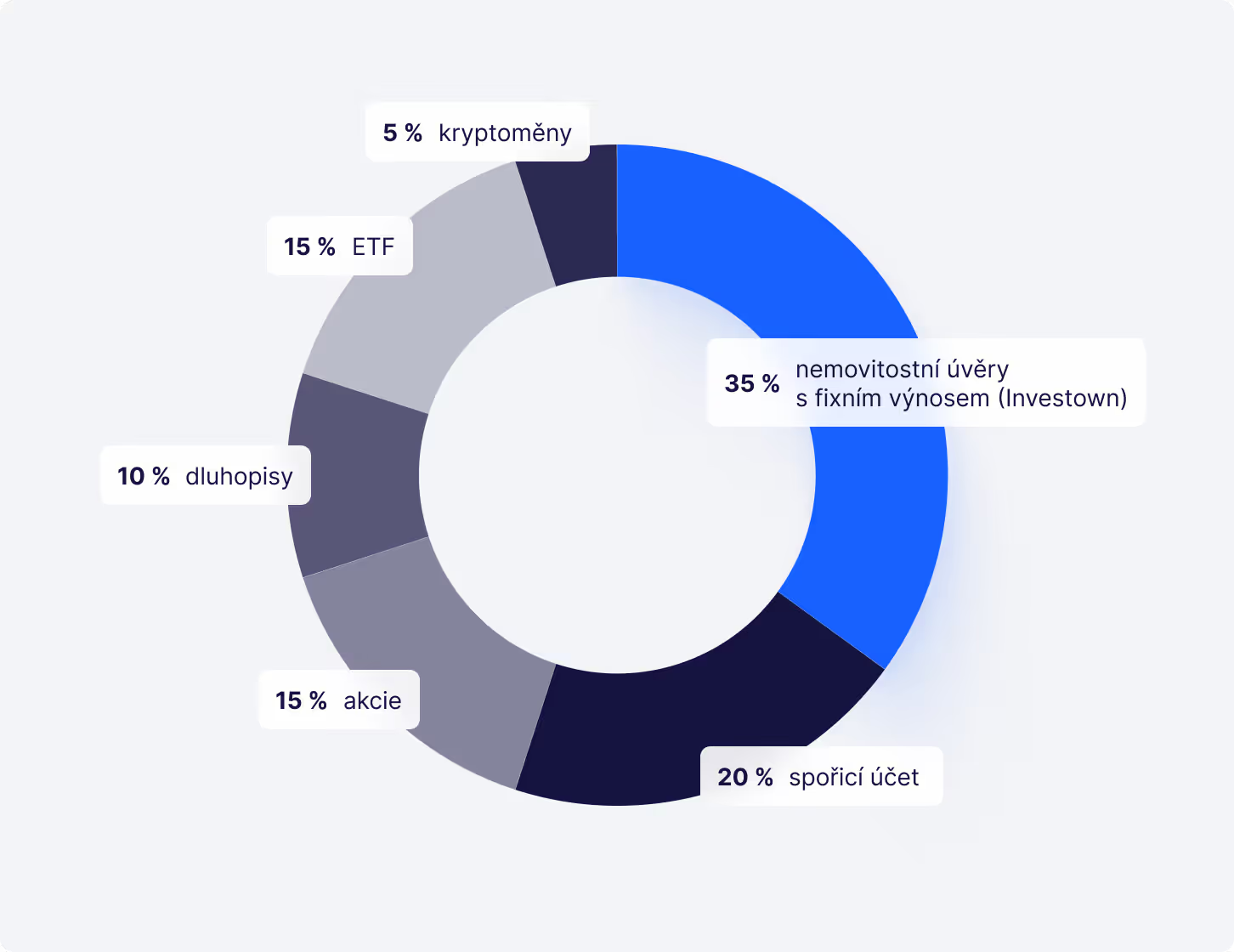
Diversification is therefore crucial when setting an investment strategy. Its degree then depends on the specific situation of each individual. While an investor with a higher risk tolerance diversifies between 3-4 assets (financial products), a more cautious investor may have 10 in their portfolio.
We wrote in detail about the diversification of the investment portfolio in of this article.
Invest smaller amounts in the beginning
There is no need at all costs and immediately invest hundreds of thousands that you have honestly saved for years. For newcomers, it is sometimes better to invest smaller amounts at the beginning, and only when they become versed in the world of investment, they “send to earn” larger amounts.
Did you know that you can invest in real estate loans on Investown from CZK 500? This is an ideal platform for all novice investors who do not want or cannot immediately invest a larger amount of funds.
Without regular education it is impossible
In conclusion, perhaps the most important. If you have decided to start investing on your own and have no experience with it, it is key to educate yourself regularly from the beginning. This is what you are doing now because you are reading this article.
Get to know each other Basic investment concepts, ask more experienced investors, read books for novice investors, or ask inspire with educational articles, for example, on our blog in the section Education.
You don't have to be the biggest investment expert right away — it's important to understand the basics and figure out why and how you want to value your money.
This article is not investment advice
Investown does not provide investment advice. This is an educational article with basic information about the beginnings of investing. For specific advice, we recommend using the services of an investment advisor.


